
Ancient Ritual Meets Modern Spectacle
Deep in the heart of Aichi Prefecture, the Konomiya Hadaka Matsuri, also known as the Konomiya Naked Festival, draws thousands of spectators each year to witness one of Japan’s most visceral displays of religious devotion and controlled chaos. Held at Owari Ōkunitama Shrine in Inazawa City, the festival centers on an ancient purification rite whose formal name—Naoi Shinji (儺追神事)—points to its spiritual purpose rather than its spectacle.
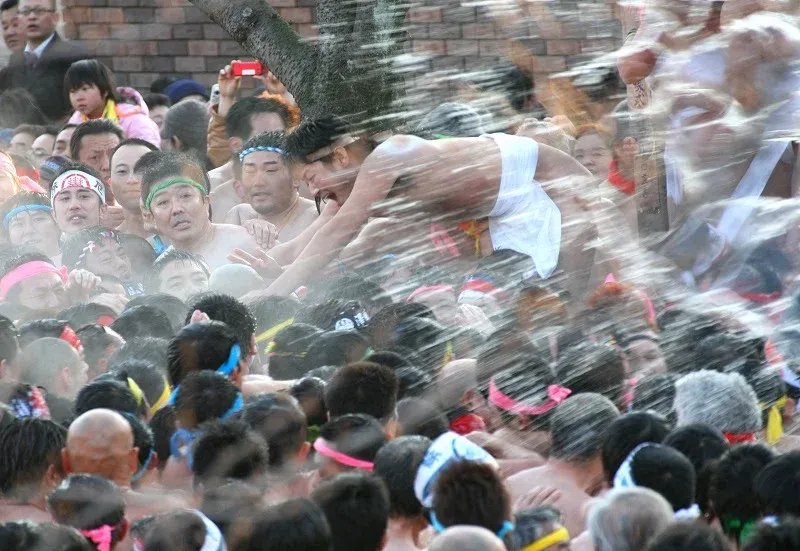
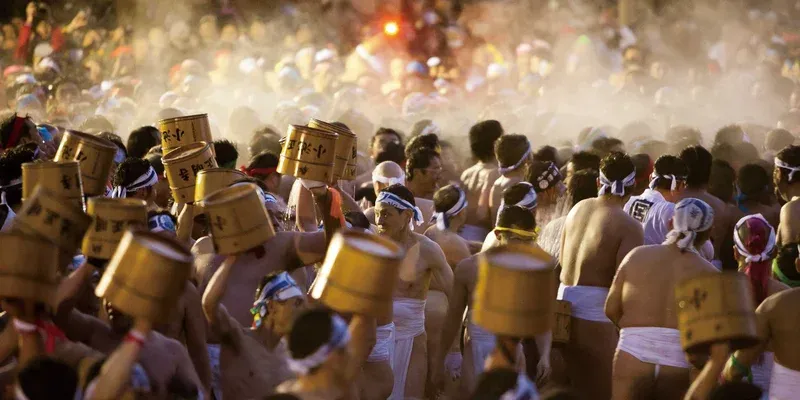
Still, it’s hard to ignore the visual impact. Hundreds of men clad only in white fundoshi and tabi socks surge through winter air, bodies slick with water, breath rising in clouds, all converging toward a single human focal point. It is this collision of belief, endurance, and raw physical energy that has made the Konomiya Hadaka Matsuri one of Japan’s most talked-about festivals.
At the heart of the ritual stands the Shin-Otoko (神男), or Sacred Man—a role assumed by one individual who undergoes extensive ritual preparation and purification in the weeks leading up to the festival. During the ceremony, he becomes the symbolic vessel for the community’s accumulated misfortune. As participants press forward and attempt to touch him, they believe their bad luck is transferred away, absorbed through contact in an act of collective purification.
For the duration of the ritual, the Shin-Otoko occupies a liminal space between the human and divine. He is neither performer nor priest, but something closer to a moving boundary—an embodiment of vulnerability onto which fear, illness, and anxiety are momentarily projected. The result is not theatrical chaos, but something closer to communal release.
Historical Origins and Meaning
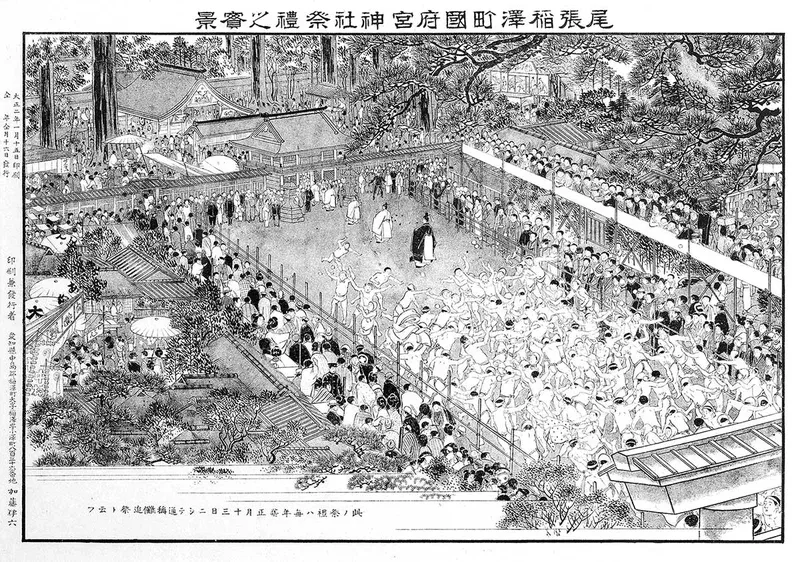
The precise origins of the Konomiya Hadaka Matsuri are difficult to pin down with historical certainty. Shrine tradition and regional histories trace the ritual back more than 1,200 years, linking it to early purification practices intended to ward off epidemics, misfortune, and social disorder. One commonly told account situates its beginnings in the late Nara period, when large-scale rites were performed across the provinces in response to widespread illness.
What is consistent across accounts is the setting. Owari Ōkunitama Shrine served as the sōsha, or central shrine, for the former Owari Province—a place where regional deities were gathered and collective rites performed on behalf of the population. The Naoi Shinji emerged from this role, evolving over centuries into the form witnessed today.
Rather than a reenactment of a single historical moment, the festival should be understood as a living ritual—reshaped over generations, sustained by belief rather than documentation. Since 2024, women have also taken part through a parallel purification rite involving bamboo grass offerings, marking a historic expansion of participation.
A Day That Builds Toward One Moment
The shrine grounds open early on festival day, and visitors arrive throughout the morning to purchase amulets and observe preliminary rites. Food stalls appear, steam rising from vats of amazake, smoke drifting from grills as the crowd slowly thickens.
By early afternoon, the atmosphere changes. Participants—identifiable by their white fundoshi—begin gathering in greater numbers, their attire signaling a deliberate stripping away of status and identity. In this state of ritual uniformity, professions and hierarchies dissolve. Everyone enters the ceremony as equal before the gods.
Spectators are advised to arrive well ahead of the main event, as viewing areas fill quickly. The central ritual takes place in the mid-afternoon, typically around 15:00, when the Shin-Otoko makes his appearance and the crowd’s restrained anticipation breaks.
What follows is a surge—bodies pressing forward in waves, hands reaching, voices shouting encouragement or warning. When contact is made, the crowd responds instantly, energy spiking as belief and physical exertion collide. Shrine officials and assistants maintain a moving perimeter around the Shin-Otoko, guiding him steadily through the mass of participants toward the inner sanctuary.
Once inside, he undergoes a final rite of purification performed by shrine priests. With this act, the ritual reaches its conclusion. The Shin-Otoko is removed from public view, symbolically carrying away what has been placed upon him. The crowd gradually disperses, tension easing, many participants drifting toward nearby food stalls or local izakaya to warm up and mark the end of the ordeal.
Related Ceremonies
The Hadaka Matsuri is part of a broader sequence of rites held over several days. These typically include the Ōkagamochi Hōnō, during which large ceremonial rice cakes are offered at the shrine, and the Ōkagamochi Kiri, when those same offerings are later cut and shared. Together, these rituals frame the main event, reinforcing themes of offering, purification, and renewal.
Practical Notes for Visitors
Weather
The festival takes place in winter, with temperatures often hovering around 5°C (41°F). Dress warmly, wear comfortable shoes, and be prepared for rain or splashing water near the ritual areas.
Money
Cash is recommended for food stalls, amulets, and festival goods. While digital payments are common in Japan, temporary vendors often operate on cash only.
Photography
Designated viewing areas are available, and the most striking moments occur during the peak of the ritual in the mid-afternoon. Visitors should be mindful of crowd movement and follow shrine staff instructions at all times.
The Konomiya Hadaka Matsuri sits at a rare intersection of endurance, belief, and spectacle. Though it has become one of central Japan’s most photographed festivals, it remains—at its core—a communal act of purification carried forward by faith rather than performance. For visitors, it offers not just an arresting visual experience, but a glimpse into how ritual continues to function in modern Japan: physical, uncomfortable, and profoundly human.
The Details
Konomiya Hadaka Matsuri (Naoi Shinji)
Venue:
Owari Ōkunitama Shrine
(Inazawa City, Aichi Prefecture)
Date:
Sun, Mar. 1, 2026
Main Ritual:
Mid-afternoon (around 15:00)
Grounds Open: Morning hours
Website:
https://www.konomiya.or.jp/
Access
The festival is easily accessible from Nagoya by train. Traffic restrictions are typically in effect around the shrine during the festival period, and parking near the grounds is extremely limited. Public transportation is strongly recommended.
By Train
From Nagoya Station, take a Meitetsu Limited Express bound for Ichinomiya and alight at Konomiya Station.
Cost / Time: Approx. ¥400 / 15–20 minutes
Exit via the West Exit, then use the underground passage on the left to cross to the east side of the tracks. After ascending the stairs, it’s a five-minute walk northeast to Owari Ōkunitama Shrine.
MAP
Nagoya Buzz publishes weekly guides to events, exhibitions, food, and the small local things that make living here easier (and occasionally stranger.)
If you enjoyed this, our Events page highlights other small, seasonal things happening around Nagoya right now.
→ See what’s happening in Nagoya this week!





Leave a Comment